AI Implementation
Building a full AI sales system from scratch (agent + tools + memory)
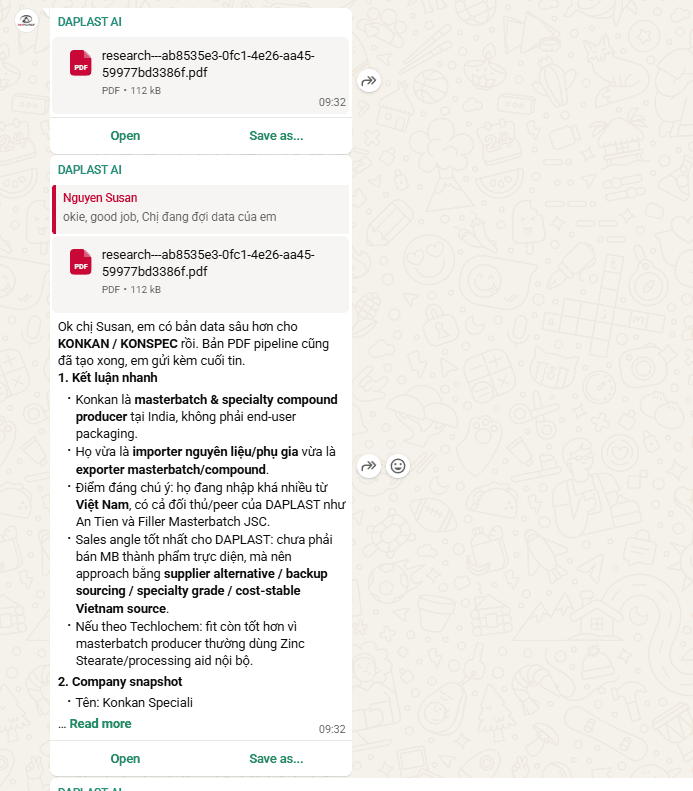
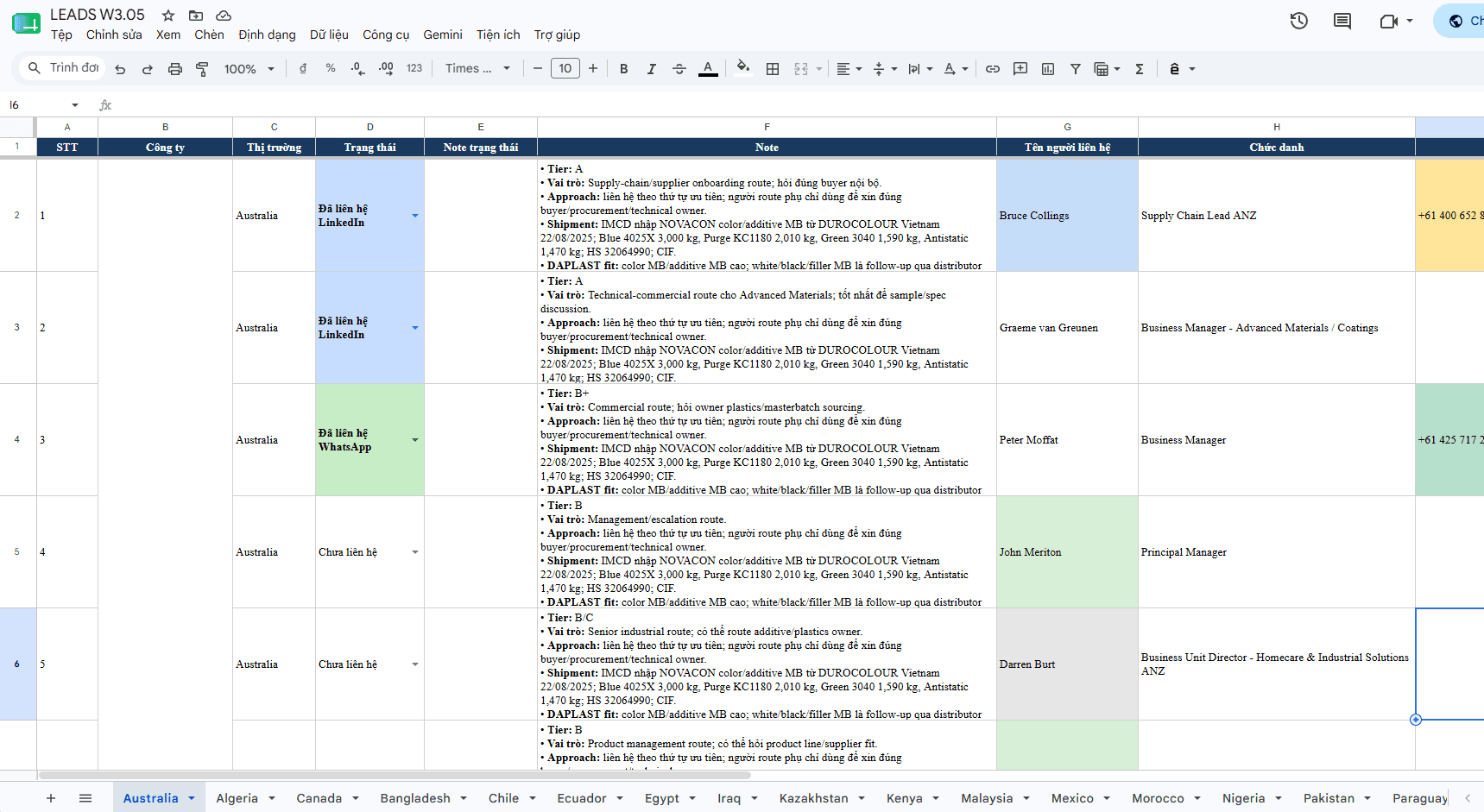
I designed, built, and ran “OpenClaw / DAPSALES” — an AI sales agent (large-language-model based) that runs 24/7 on a cloud server (DigitalOcean, Singapore) and is controlled from WhatsApp, with a Zalo channel too. It serves the whole sales team in a shared group and in private chats: it researches target companies, qualifies leads, drafts emails and quotes, looks up competitors, and sends a competitor-news briefing every morning. It helped grow the qualified-lead database to about 20,000 companies across 34 countries — with no new staff. I build, tune, and run the whole system hands-on with Claude (Claude Code).
Year :
2026
Industry :
B2B Manufacturing / Export
Client :
DAPLAST JSC
Project Duration :
Mar 2026 – Jun 2026

Problem :
B2B export sales was slow and fully manual, across 30+ markets and many languages. Finding companies, working out the real buyer, getting a correct email or phone, checking competitors, and writing each message was all done by hand, one lead at a time. Coverage stayed small, the data was messy, follow-ups were forgotten, and the team had no easy way to see what competitors were doing. They needed to do far more with the same people — and an AI that talks to real customers and a whole sales team could not be allowed to send wrong, unsafe, or made-up information.

Solution :
I built OpenClaw as a full system, not just a chatbot.
Always-on agent: it runs 24/7 on a cloud server, talks to the team on WhatsApp (group + private chats) and Zalo, and routes to top models (including Claude) through a self-hosted gateway. I build, tune, and operate the whole system hands-on with Claude (Claude Code), and rely on Claude for the deeper, specialized work.
A real knowledge base the agent reads every time: company and product data, 17 competitors, 14 common objections with answers, a sales methodology, quote templates, and cold-email templates in Vietnamese and English by industry and region — plus a separate brand (a subsidiary) kept fully separate so it can sell to the parent's competitors without conflict.
Long-term memory: each lead has its own memory (a local vector database), so the bot remembers context instead of starting over.
Many tools (14+ command-line wrappers plus an connector): web search with automatic 4-engine fallback, trade and shipment data, company registries, contact/company enrichment (including phone reveal), Google Maps scraping, website crawling, OCR, email verification, OSINT, and a stealth browser for blocked pages.
Eight ready output formats: company research, contact intel, cold email, quote draft, objection response, competitor battlecard, market-opportunity sizing, and a 5-touch follow-up sequence.
Built-in automation (see the companion project): daily competitor-news briefings, a follow-up queue, and a reply-queue check every 30 minutes.
Safety and control by design: an owner-vs-team permission model, an approval step before a new person can chat with the bot, verified-data rules, and a human review before anything reaches a customer.


Challenge :
The work was as much engineering and trust as it was AI.
Accuracy and safety: an AI that talks to customers and a whole sales team must not make things up, so I built verified-data rules, a human review before customer-facing messages, and clear “never overpromise certificates, prices, or lead time” guardrails.
Running it on a small, cheap server: with only 2 CPUs and 4 GB of RAM, two heavy browser tasks at once would crash it, so I designed a “phased” workflow that keeps heavy jobs sequential and light/cloud jobs parallel, and added swap and memory guards. • Keeping costs near zero: I rotated across 6 free API keys so the team effectively got 6× the free quota, with daily spend caps, per-user limits, and a spend log.
Reliability: every change is backed up first, the config hot-reloads without downtime, and I built a one-command health check (service, memory, WhatsApp status, cron results, errors).
People: it had to be usable and trusted by non-technical salespeople, so I proposed it, proved it with results, and led the rollout after management approved.
Summary :
OpenClaw turned a manual, one-lead-at-a-time sales process into a supervised, always-on AI system the whole team uses every day. It grew the qualified-lead database to about 20,000 companies across 34 countries with no new staff. It shows I can design, build, run, and govern a real AI system end to end — model, tools, memory, knowledge, automation, safety, and cost — which is exactly what an “AI Specialist” role needs.

More Projects


AI Implementation
Building a full AI sales system from scratch (agent + tools + memory)
I designed, built, and ran “OpenClaw / DAPSALES” — an AI sales agent (large-language-model based) that runs 24/7 on a cloud server (DigitalOcean, Singapore) and is controlled from WhatsApp, with a Zalo channel too. It serves the whole sales team in a shared group and in private chats: it researches target companies, qualifies leads, drafts emails and quotes, looks up competitors, and sends a competitor-news briefing every morning. It helped grow the qualified-lead database to about 20,000 companies across 34 countries — with no new staff. I build, tune, and run the whole system hands-on with Claude (Claude Code).
Year :
2026
Industry :
B2B Manufacturing / Export
Client :
DAPLAST JSC
Project Duration :
Mar 2026 – Jun 2026
Problem :
B2B export sales was slow and fully manual, across 30+ markets and many languages. Finding companies, working out the real buyer, getting a correct email or phone, checking competitors, and writing each message was all done by hand, one lead at a time. Coverage stayed small, the data was messy, follow-ups were forgotten, and the team had no easy way to see what competitors were doing. They needed to do far more with the same people — and an AI that talks to real customers and a whole sales team could not be allowed to send wrong, unsafe, or made-up information.
Solution :
I built OpenClaw as a full system, not just a chatbot.
Always-on agent: it runs 24/7 on a cloud server, talks to the team on WhatsApp (group + private chats) and Zalo, and routes to top models (including Claude) through a self-hosted gateway. I build, tune, and operate the whole system hands-on with Claude (Claude Code), and rely on Claude for the deeper, specialized work.
A real knowledge base the agent reads every time: company and product data, 17 competitors, 14 common objections with answers, a sales methodology, quote templates, and cold-email templates in Vietnamese and English by industry and region — plus a separate brand (a subsidiary) kept fully separate so it can sell to the parent's competitors without conflict.
Long-term memory: each lead has its own memory (a local vector database), so the bot remembers context instead of starting over.
Many tools (14+ command-line wrappers plus an connector): web search with automatic 4-engine fallback, trade and shipment data, company registries, contact/company enrichment (including phone reveal), Google Maps scraping, website crawling, OCR, email verification, OSINT, and a stealth browser for blocked pages.
Eight ready output formats: company research, contact intel, cold email, quote draft, objection response, competitor battlecard, market-opportunity sizing, and a 5-touch follow-up sequence.
Built-in automation (see the companion project): daily competitor-news briefings, a follow-up queue, and a reply-queue check every 30 minutes.
Safety and control by design: an owner-vs-team permission model, an approval step before a new person can chat with the bot, verified-data rules, and a human review before anything reaches a customer.
Challenge :
The work was as much engineering and trust as it was AI.
Accuracy and safety: an AI that talks to customers and a whole sales team must not make things up, so I built verified-data rules, a human review before customer-facing messages, and clear “never overpromise certificates, prices, or lead time” guardrails.
Running it on a small, cheap server: with only 2 CPUs and 4 GB of RAM, two heavy browser tasks at once would crash it, so I designed a “phased” workflow that keeps heavy jobs sequential and light/cloud jobs parallel, and added swap and memory guards. • Keeping costs near zero: I rotated across 6 free API keys so the team effectively got 6× the free quota, with daily spend caps, per-user limits, and a spend log.
Reliability: every change is backed up first, the config hot-reloads without downtime, and I built a one-command health check (service, memory, WhatsApp status, cron results, errors).
People: it had to be usable and trusted by non-technical salespeople, so I proposed it, proved it with results, and led the rollout after management approved.
Summary :
OpenClaw turned a manual, one-lead-at-a-time sales process into a supervised, always-on AI system the whole team uses every day. It grew the qualified-lead database to about 20,000 companies across 34 countries with no new staff. It shows I can design, build, run, and govern a real AI system end to end — model, tools, memory, knowledge, automation, safety, and cost — which is exactly what an “AI Specialist” role needs.
More Projects
AI Implementation
Building a full AI sales system from scratch (agent + tools + memory)
I designed, built, and ran “OpenClaw / DAPSALES” — an AI sales agent (large-language-model based) that runs 24/7 on a cloud server (DigitalOcean, Singapore) and is controlled from WhatsApp, with a Zalo channel too. It serves the whole sales team in a shared group and in private chats: it researches target companies, qualifies leads, drafts emails and quotes, looks up competitors, and sends a competitor-news briefing every morning. It helped grow the qualified-lead database to about 20,000 companies across 34 countries — with no new staff. I build, tune, and run the whole system hands-on with Claude (Claude Code).
Year :
2026
Industry :
B2B Manufacturing / Export
Client :
DAPLAST JSC
Project Duration :
Mar 2026 – Jun 2026
Problem :
B2B export sales was slow and fully manual, across 30+ markets and many languages. Finding companies, working out the real buyer, getting a correct email or phone, checking competitors, and writing each message was all done by hand, one lead at a time. Coverage stayed small, the data was messy, follow-ups were forgotten, and the team had no easy way to see what competitors were doing. They needed to do far more with the same people — and an AI that talks to real customers and a whole sales team could not be allowed to send wrong, unsafe, or made-up information.
Solution :
I built OpenClaw as a full system, not just a chatbot.
Always-on agent: it runs 24/7 on a cloud server, talks to the team on WhatsApp (group + private chats) and Zalo, and routes to top models (including Claude) through a self-hosted gateway. I build, tune, and operate the whole system hands-on with Claude (Claude Code), and rely on Claude for the deeper, specialized work.
A real knowledge base the agent reads every time: company and product data, 17 competitors, 14 common objections with answers, a sales methodology, quote templates, and cold-email templates in Vietnamese and English by industry and region — plus a separate brand (a subsidiary) kept fully separate so it can sell to the parent's competitors without conflict.
Long-term memory: each lead has its own memory (a local vector database), so the bot remembers context instead of starting over.
Many tools (14+ command-line wrappers plus an connector): web search with automatic 4-engine fallback, trade and shipment data, company registries, contact/company enrichment (including phone reveal), Google Maps scraping, website crawling, OCR, email verification, OSINT, and a stealth browser for blocked pages.
Eight ready output formats: company research, contact intel, cold email, quote draft, objection response, competitor battlecard, market-opportunity sizing, and a 5-touch follow-up sequence.
Built-in automation (see the companion project): daily competitor-news briefings, a follow-up queue, and a reply-queue check every 30 minutes.
Safety and control by design: an owner-vs-team permission model, an approval step before a new person can chat with the bot, verified-data rules, and a human review before anything reaches a customer.
Challenge :
The work was as much engineering and trust as it was AI.
Accuracy and safety: an AI that talks to customers and a whole sales team must not make things up, so I built verified-data rules, a human review before customer-facing messages, and clear “never overpromise certificates, prices, or lead time” guardrails.
Running it on a small, cheap server: with only 2 CPUs and 4 GB of RAM, two heavy browser tasks at once would crash it, so I designed a “phased” workflow that keeps heavy jobs sequential and light/cloud jobs parallel, and added swap and memory guards. • Keeping costs near zero: I rotated across 6 free API keys so the team effectively got 6× the free quota, with daily spend caps, per-user limits, and a spend log.
Reliability: every change is backed up first, the config hot-reloads without downtime, and I built a one-command health check (service, memory, WhatsApp status, cron results, errors).
People: it had to be usable and trusted by non-technical salespeople, so I proposed it, proved it with results, and led the rollout after management approved.
Summary :
OpenClaw turned a manual, one-lead-at-a-time sales process into a supervised, always-on AI system the whole team uses every day. It grew the qualified-lead database to about 20,000 companies across 34 countries with no new staff. It shows I can design, build, run, and govern a real AI system end to end — model, tools, memory, knowledge, automation, safety, and cost — which is exactly what an “AI Specialist” role needs.