AI Implementation
Building 20 custom AI data tools (MCP servers)
I designed and coded about 20 custom MCP servers (Model Context Protocol) from scratch. Together they give an AI agent 90+ tools to pull checked data on companies, customs, trade, and business registries in dozens of countries — including free options that replace costly paid databases.
Year :
2026
Industry :
AI Tooling / B2B Data
Client :
Self-built (used at DAPLAST)
Project Duration :
2026

Problem :
An AI agent is only as strong as the tools it can call. For B2B sales research, the useful data lives in many separate places: company registries, customs and shipment records, trade flows, public tenders, and local business directories — each in a different country and a different format. Paid databases that combine some of this are expensive and still limited, and no single one covers everything. To make AI prospecting really work, the agent needed wide, reliable, multi-country data it could pull on demand, without paying for several costly subscriptions.

Solution :
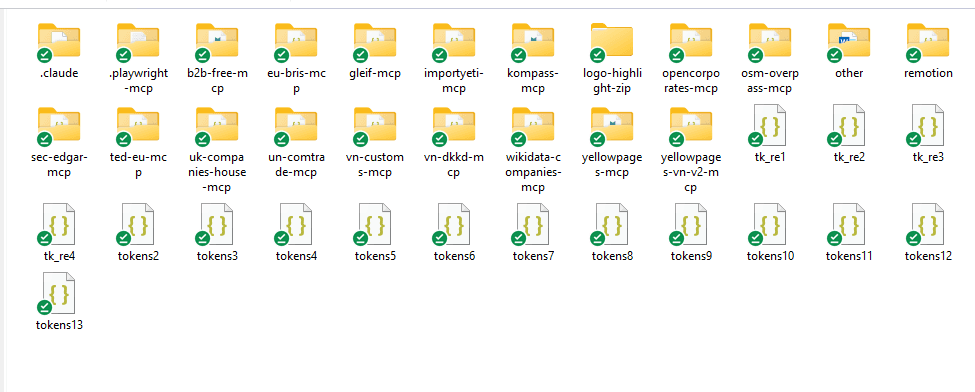
I designed and coded about 20 MCP servers from scratch, in TypeScript and Python, building them with Claude (Claude Code). Each one wraps a real data source into clean tools an AI agent can call.
The bigger ones: kompass (14 tools) for B2B company search; a b2b-free hub that combines 6 free sources (18 tools); gleif (9 tools) for free, unlimited company-ID (LEI) data — a real replacement for paid OpenCorporates; a top-tier intel pack of ImportYeti, EU tenders (TED), SEC filings, UN trade data, and Vietnam customs (26 tools).
On top of those I built servers for OpenCorporates, UK Companies House, EU BRIS, Wikidata, and OSM maps for factory locations, plus channel tools for WhatsApp, LinkedIn, and Tradesparq. I added one search across sources that removes duplicates by tax ID or phone, registered everything so the agent can use it all together, and chose free sources to replace paid ones wherever I could.

Challenge :
Every source is different — its own API or web page, its own rate limits, its own login — so each server needed its own design and careful error handling.
The interesting part was making 20 separate tools feel like one toolkit: one search, no duplicate companies, and free options swapped in for paid ones (for example, GLEIF instead of paid OpenCorporates) so coverage stayed wide without the cost. Keeping them all stable and registered as sources changed took ongoing work. My own setup notes record the outcome: the local toolkit ended up “more complete than the OpenClaw server.”
Summary :
These ~20 servers turned a normal AI into a real B2B research engine, and they are the actual work behind the single CV line “20+ MCP tools.” The project shows genuine software skills, hands-on API integration, and systems thinking far beyond “basic API knowledge.” In short, I can look at a slow, manual data task and build the tools that make an AI do it — which is the core of applying AI to real work.
More Projects


AI Implementation
Building 20 custom AI data tools (MCP servers)
I designed and coded about 20 custom MCP servers (Model Context Protocol) from scratch. Together they give an AI agent 90+ tools to pull checked data on companies, customs, trade, and business registries in dozens of countries — including free options that replace costly paid databases.
Year :
2026
Industry :
AI Tooling / B2B Data
Client :
Self-built (used at DAPLAST)
Project Duration :
2026
Problem :
An AI agent is only as strong as the tools it can call. For B2B sales research, the useful data lives in many separate places: company registries, customs and shipment records, trade flows, public tenders, and local business directories — each in a different country and a different format. Paid databases that combine some of this are expensive and still limited, and no single one covers everything. To make AI prospecting really work, the agent needed wide, reliable, multi-country data it could pull on demand, without paying for several costly subscriptions.
Solution :
I designed and coded about 20 MCP servers from scratch, in TypeScript and Python, building them with Claude (Claude Code). Each one wraps a real data source into clean tools an AI agent can call.
The bigger ones: kompass (14 tools) for B2B company search; a b2b-free hub that combines 6 free sources (18 tools); gleif (9 tools) for free, unlimited company-ID (LEI) data — a real replacement for paid OpenCorporates; a top-tier intel pack of ImportYeti, EU tenders (TED), SEC filings, UN trade data, and Vietnam customs (26 tools).
On top of those I built servers for OpenCorporates, UK Companies House, EU BRIS, Wikidata, and OSM maps for factory locations, plus channel tools for WhatsApp, LinkedIn, and Tradesparq. I added one search across sources that removes duplicates by tax ID or phone, registered everything so the agent can use it all together, and chose free sources to replace paid ones wherever I could.
Challenge :
Every source is different — its own API or web page, its own rate limits, its own login — so each server needed its own design and careful error handling.
The interesting part was making 20 separate tools feel like one toolkit: one search, no duplicate companies, and free options swapped in for paid ones (for example, GLEIF instead of paid OpenCorporates) so coverage stayed wide without the cost. Keeping them all stable and registered as sources changed took ongoing work. My own setup notes record the outcome: the local toolkit ended up “more complete than the OpenClaw server.”
Summary :
These ~20 servers turned a normal AI into a real B2B research engine, and they are the actual work behind the single CV line “20+ MCP tools.” The project shows genuine software skills, hands-on API integration, and systems thinking far beyond “basic API knowledge.” In short, I can look at a slow, manual data task and build the tools that make an AI do it — which is the core of applying AI to real work.
More Projects
AI Implementation
Building 20 custom AI data tools (MCP servers)
I designed and coded about 20 custom MCP servers (Model Context Protocol) from scratch. Together they give an AI agent 90+ tools to pull checked data on companies, customs, trade, and business registries in dozens of countries — including free options that replace costly paid databases.
Year :
2026
Industry :
AI Tooling / B2B Data
Client :
Self-built (used at DAPLAST)
Project Duration :
2026
Problem :
An AI agent is only as strong as the tools it can call. For B2B sales research, the useful data lives in many separate places: company registries, customs and shipment records, trade flows, public tenders, and local business directories — each in a different country and a different format. Paid databases that combine some of this are expensive and still limited, and no single one covers everything. To make AI prospecting really work, the agent needed wide, reliable, multi-country data it could pull on demand, without paying for several costly subscriptions.
Solution :
I designed and coded about 20 MCP servers from scratch, in TypeScript and Python, building them with Claude (Claude Code). Each one wraps a real data source into clean tools an AI agent can call.
The bigger ones: kompass (14 tools) for B2B company search; a b2b-free hub that combines 6 free sources (18 tools); gleif (9 tools) for free, unlimited company-ID (LEI) data — a real replacement for paid OpenCorporates; a top-tier intel pack of ImportYeti, EU tenders (TED), SEC filings, UN trade data, and Vietnam customs (26 tools).
On top of those I built servers for OpenCorporates, UK Companies House, EU BRIS, Wikidata, and OSM maps for factory locations, plus channel tools for WhatsApp, LinkedIn, and Tradesparq. I added one search across sources that removes duplicates by tax ID or phone, registered everything so the agent can use it all together, and chose free sources to replace paid ones wherever I could.
Challenge :
Every source is different — its own API or web page, its own rate limits, its own login — so each server needed its own design and careful error handling.
The interesting part was making 20 separate tools feel like one toolkit: one search, no duplicate companies, and free options swapped in for paid ones (for example, GLEIF instead of paid OpenCorporates) so coverage stayed wide without the cost. Keeping them all stable and registered as sources changed took ongoing work. My own setup notes record the outcome: the local toolkit ended up “more complete than the OpenClaw server.”
Summary :
These ~20 servers turned a normal AI into a real B2B research engine, and they are the actual work behind the single CV line “20+ MCP tools.” The project shows genuine software skills, hands-on API integration, and systems thinking far beyond “basic API knowledge.” In short, I can look at a slow, manual data task and build the tools that make an AI do it — which is the core of applying AI to real work.